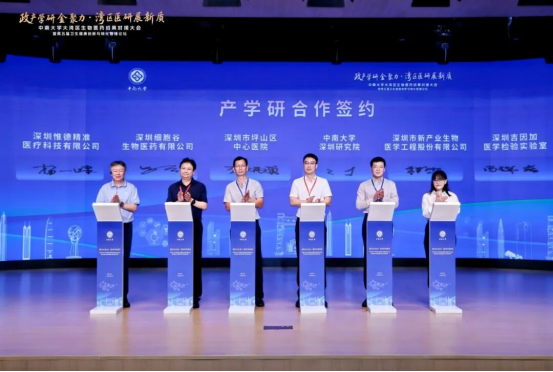
Recently, the Greater Bay Area Biomedical Achievements Matching Conference of Central South University (CSU) and the 5th Forum on Health Innovation and Translation were grandly held at Shenzhen Pingshan District Central Hospital. Professor Shi Yuanyuan, founder of Shenzhen Cell Valley, was invited to attend and signed an industry-academia-research cooperation agreement on behalf of the company with the CSU Shenzhen Research Institute.
Themed "Synergy of Government, Industry, Academia, Research, and Finance to Unleash New Quality in Bay Area Medical Research," the conference was jointly organized by the Xiangya School of Medicine at Central South University and the CSU Shenzhen Research Institute. Distinguished attendees included Chen Xiang, Member of the Standing Committee of the CSU Party Committee, Executive Vice President of CSU, and Dean of Xiangya School of Medicine; Yang Tao, Member of the Standing Committee of the Pingshan District Party Committee and Deputy District Mayor of Pingshan District; and Yang Yifeng, Dean of Shenzhen Pingshan District Central Hospital. The event gathered representatives from universities, enterprises, medical institutions, and government departments to explore collaborative innovation pathways in the biomedical sector.
This significant partnership between Shenzhen Cell Valley and the CSU Shenzhen Research Institute will focus on core areas including joint R&D, clinical translation, and talent development, injecting new momentum into the high-quality development of the biomedical industry in the Greater Bay Area. The collaboration aims to integrate the advantageous resources of both parties to build a full-chain synergistic innovation model encompassing "basic research + clinical translation + industrial application." Both sides will engage in deep cooperation centered on developing innovative joint R&D pipelines, focusing on major disease areas such as cancer and autoimmune diseases. Together, they will develop cutting-edge cell therapy products, including CAR-T and CAR-NK therapies based on retroviral vector technology, accelerating the translation of scientific achievements from the laboratory to the clinic. Furthermore, leveraging the Precision Medicine Research and Translation Platform of the CSU Shenzhen Research Institute, the partners will facilitate efficient alignment between clinical needs and technological R&D.
Looking ahead, taking this signing as a starting point, both parties will continue to explore new models for the deep integration of government, industry, academia, and research, contributing to the high-quality development of the biomedical industry in the Guangdong-Hong Kong-Macao Greater Bay Area.
 Scan to follow our latest news
 Working hours: Monday to Friday, 9:00-18:00
Contact:Ms. Lai
Email:laijiaqi@sz-cell.com
Address:No. 1, Rongtian Road, Jinsha Community, Kengzi Street, Pingshan District, Shenzhen, China (Hepure Biomedical Ecological Park)